How to Fix Golf Slice Fast with Proven Drills

Coach Author Profile Pic
February 2, 2026

Golf Slice Fix – Proven Drills To Straighten Your Shots Fast

Introduction

Every golfer has that one shot they almost want to look away from. For most players asking how to fix a golf slice, it is that high, weak ball that peels off to the right, dives into trees or rough, and turns a decent swing into instant trouble.

We see this pattern all the time. Around nine out of ten amateur golfers fight a slice and many try to simply aim left and live with it. A slice is not just a small quirk; it is a clear sign that the clubface and swing path are working against each other, which costs you distance, accuracy, and confidence.

The positive news: a slice has clear causes and clear fixes. When you combine:

  • suitable equipment,
  • a stronger grip,
  • better body movement, and
  • a repeatable drill that changes your swing path,

that weak “banana ball” can turn into a strong, penetrating flight.

At Elite Golf Academies we use PGA European Tour inspired coaching, TrackMan 4 data, high-speed cameras, and 3D motion analysis to show players exactly how to fix a golf slice in a measured, practical way.

By the end of this guide you will understand why the ball slices, how driver setup and grip start the pattern, how the loop drill re-trains your path, and how your release and body sequence complete the fix.

“The fundamentals are the building blocks of fun.”
— Jack Nicklaus

Key Takeaways

  • A slice comes from two things at impact: an open clubface and an out‑to‑in swing path. When those combine, you get heavy sidespin, lost distance, and the classic curve right. Any plan for how to fix a golf slice must deal with both face and path.

  • Early steps often happen before you swing: choosing a driver with enough loft and building a stronger grip. These changes help the face square, let the hands release without tension, and make it easier to swing from the inside instead of over the top.

  • Lasting change comes from drills and feedback that build a new pattern: the three-part loop drill, simple path drills, a natural release, and better lower body sequencing. Backed by TrackMan data and PGA coaching at Elite Golf Academies, golfers move from guessing to a clear, data‑driven plan.

Understanding Why You Slice – The Root Causes Of Your Frustration

For a right‑handed golfer, a slice is a shot that starts near the target (or even left of it) and then curves hard to the right with a high, weak flight. It feels like the ball has no punch and can lose tens of yards compared to a solid, straight shot.

Two numbers at impact create that curve:

  • Clubface angle – for a slicer, the face points right of the target.
  • Swing path – the club travels from outside the target line back across the ball (out‑to‑in).

When the face is open to both the target and the swing path, the ball starts right and then curves even farther right.

Modern ball‑flight laws show:

  • The face angle controls most of the starting direction.
  • The swing path controls how much the ball curves.

A typical slicer swings steeply, throws the club “over the top” with the shoulders, and cuts across the ball. That over‑the‑top move adds sidespin on top of an open face, producing the big curve.

Behind that move is a chain reaction:

  • Many players start with a weak grip (hands turned too far toward the target).
  • That grip makes it hard to close the face.
  • The brain reacts by swinging left across the ball to keep it on the planet.
  • Over time, that steep, out‑to‑in move becomes the default pattern and the slice often gets worse.

A hook is the opposite: the face is more closed than the path. While a big hook can be wild, many good players intentionally hit a small right‑to‑left curve. A slice, by contrast, shows that face and path are badly out of sync, which makes consistent ball striking much harder.

At Elite Golf Academies, we measure all this instead of guessing. TrackMan 4 gives exact numbers for:

  • face angle
  • swing path
  • attack angle
  • spin axis
  • ball speed and launch

We might see a path 5° left with a face 3° open, then show you how those numbers change as we adjust your grip, path, and release. This clear picture makes the next steps far more effective.

“If you can’t measure it, you can’t improve it.”
— Often attributed to Peter Drucker (and very true for golf swings)

Is Your Equipment Working Against You – Driver Evaluation And Setup

Many players look for how to fix a golf slice by changing their swing but never question whether their driver is helping or hurting.

One common mistake: a slicer using very low loft because they believe a lower number means more distance. Often, that choice makes the slice worse.

  • A driver with too little loft demands perfect timing to square the face.
  • If the face is even slightly open, low loft keeps the ball from launching well and adds more sidespin.
  • The result is a high, spinny shot that starts right and curves farther right.

For many slicers, 10.5–12 degrees of loft:

  • softens spin,
  • makes it easier to launch the ball,
  • and reduces curve.

Modern adjustable drivers add even more help:

  • You can add loft.
  • You can move weight inside the head.
  • Moving weight toward the heel encourages the toe to rotate, helping the face close.

There is also a twist many golfers miss:
If you swing a 10.5° driver with freedom and square the face, your launch can be lower and stronger than with a 9° head you hold open. That open face adds loft at impact, so your 9° driver can behave like 11° with lots of sidespin.

At Elite Golf Academies, we fit drivers using Taylormade and PING fitting studios plus TrackMan data. We look at:

  • club speed
  • launch angle
  • spin rate
  • strike pattern

Then we match loft, shaft, and head settings to your swing. Many golfers reduce their slice and gain distance the same day simply by moving to a higher loft and a draw‑biased setup.

Once your driver is helping you rather than fighting you, the next step is your grip, the only direct contact you have with the club.
Your Foundation For Success – Building A Proper Grip

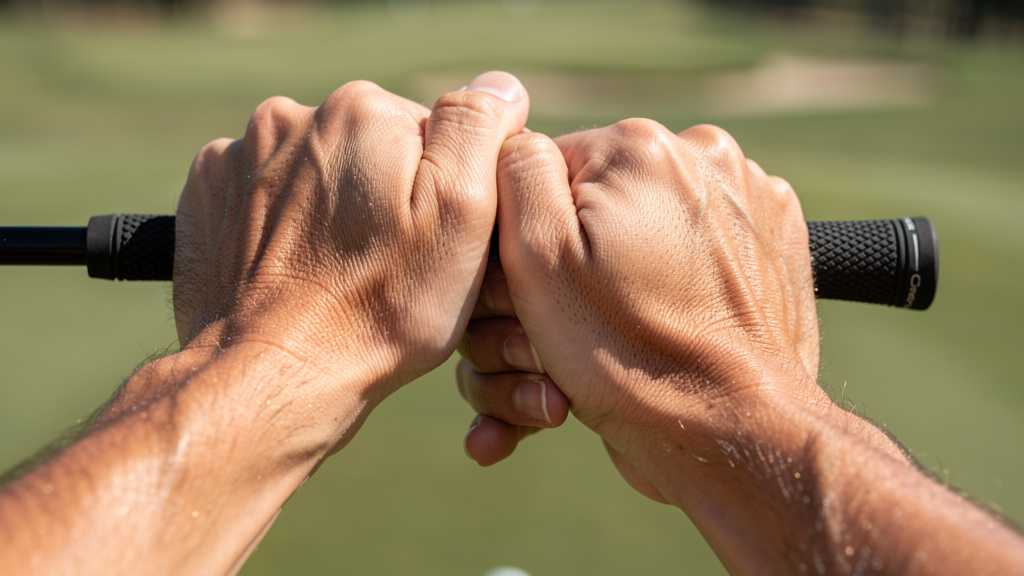
Close-up of correct stronger golf grip technique

When golfers ask us how to fix a golf slice, we often start with their hands before we touch the swing. The grip controls how the clubface behaves. If the hands sit in a weak position, the face wants to stay open, no matter how hard you try to swing from the inside.

For a right‑handed player, a weak grip usually means:

  • thumbs run straight down the top of the shaft,
  • hands sit too far toward the target,
  • you see only one knuckle on the lead hand,
  • the “V”s between thumbs and index fingers point at your chin or lead shoulder.

This keeps the lead hand’s back facing the target and the clubface open.

To build a stronger grip:

  1. Lead hand

    • Place the club across the base of your fingers.
    • Wrap your hand so you see at least two (often three) knuckles.
    • The lead‑hand “V” should point toward your trail shoulder.
  2. Trail hand

    • Match the trail palm to the angle of the lead palm.
    • The trail‑hand “V” should also point toward your trail shoulder.
    • The palms should feel like they face each other and work as one unit.
  3. Grip pressure

    • Many slicers squeeze far too hard.
    • On a 1–10 scale, aim for a 3 or 4.
    • Picture holding a tube of toothpaste without squeezing any out.

A softer hold lets the clubhead swing, helps the face rotate, and supports a natural release.

At Elite Golf Academies we often film the grip with high‑speed cameras. We check whether the hands keep that stronger position or roll back toward weak during the takeaway. Players then make slow practice swings with the new grip and light pressure, feeling the weight of the clubhead and a gentle roll of the forearms through the ball.

Once your hands support a square face, you are ready for the drill that changes the path.

The Game-Changing Loop Drill – Retraining Your Swing Path

Even with better equipment and grip, a slice will hang around if the club path stays out‑to‑in. Many golfers pull the club too far inside in the backswing, then throw it over the top on the way down. The loop drill we use at Elite Golf Academies teaches the opposite move and sits at the heart of how to fix a golf slice for good.

Based on a three‑part loop popularized by coach Hank Haney, the goal is to:

  • move the club on a shallower plane, and
  • approach the ball from the inside.

Practice slowly at first. Speed comes later.

Step 1 – Draw A Backward Loop

  1. Take your normal stance with the stronger grip and the ball inside your lead heel.
  2. Set the clubhead 30 cm in front of the ball on the target line (not behind it).
  3. Move the club in a slow, smooth circle:
    • along the target line toward the target,
    • up and around your head,
    • then looping down so it passes over the top of the ball position.

From your view this is a clockwise loop. You are not trying to hit the ball yet.

As you repeat this large circle:

  • feel the club naturally fall onto a shallower path,
  • notice your hands and forearms rolling,
  • sense the clubhead approaching from inside the target line.

Do 10–15 slow loops with no ball. In our academies we often pair this with 3D motion analysis to show how different this shallower loop is from a steep, over‑the‑top move.

Step 2 – Lift, Turn, And Shallow The Club

  1. Address the ball with the clubhead behind it as normal.
  2. Lift the club straight up until your hands are in front of your face (no body turn yet).
  3. Start your backswing by turning your shoulders away from the target.

As you turn, feel:

  • the clubhead dropping behind you,
  • the shaft shallowing instead of tipping out in front,
  • the club falling behind your hands.

From the top, swing down and let the club travel back over the ball, like the lower half of that clockwise loop.

Repeat 8–10 times, focusing on:

  • turning,
  • letting the club fall behind you,
  • and approaching from the inside.

At Elite Golf Academies, we often track this step on TrackMan to show the swing path number moving:

  • from negative (out‑to‑in)
  • toward neutral or slightly positive (in‑to‑out).

Step 3 – Transition To Full Swing And Ball Contact

  1. Take the club back into a two‑thirds backswing, with your lead arm parallel to the ground. Pause briefly.
  2. Complete your shoulder turn to the top, keeping the club feeling behind you, not above you.
  3. Start the downswing by letting the club drop from the inside while you turn through.

Begin by hitting shots at 60–70% speed. Your goal:

  • send the club along that inside path,
  • allow the face to square naturally.

You may see some shots start slightly right and curve gently left. That small draw is a clear sign the pattern is changing.

If the ball still slices, slow down more and exaggerate the feeling of the club coming from the inside. At Elite Golf Academies, we suggest:

  • 20–30 balls with this focus at the start of each practice session,
  • for 2–3 weeks,

so the new path starts to feel normal.
Complementary Path Drills – Additional Training Tools

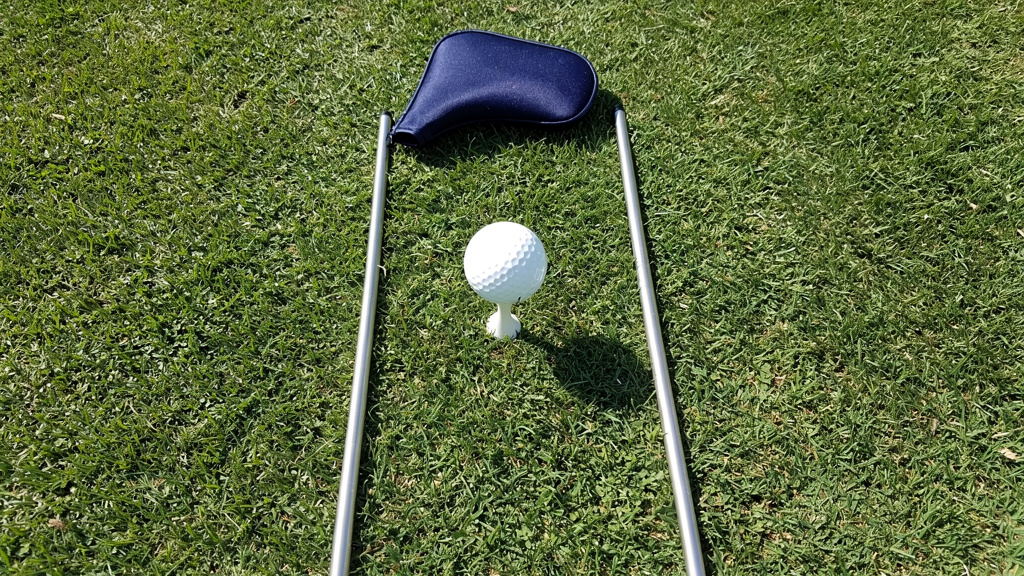
Overhead view of golf training drill setup

Different golfers react to different feels. Once you understand the loop drill, these two simple exercises give instant feedback on whether you are swinging from the inside or slipping back into an over‑the‑top pattern.

The Headcover Drill

This drill uses a small obstacle to keep you off the outside path:

  1. Place an empty headcover (or rolled towel) 15 cm outside and slightly behind the ball.
  2. Take your normal setup.
  3. Make swings trying not to hit the headcover.

If you come over the top and cut across the ball, the clubhead will collide with the headcover. To miss it, the club must approach from the inside.

Start with easy swings, even without a ball. As you gain consistency:

  • add a ball,
  • slowly build speed,
  • still avoid the headcover.

At Elite Golf Academies, we often pair this with TrackMan so players can see the link between:

  • missing the headcover, and
  • a swing path that moves toward neutral or slightly in‑to‑out.

The Gate Drill

The gate drill gives you a visual and physical guide:

  1. Place two objects (alignment sticks or headcovers) to form a narrow “gate” around the ball:
    • one just outside and behind the ball,
    • the other just inside and in front.
  2. Your task: swing the clubhead through the gate without touching either object.

To succeed, the club must:

  • move from inside the line by the first marker,
  • then back out toward the target beyond the second marker.

Begin with a wider gate (around 30 cm), then narrow it as your control improves. For advanced practice, we sometimes angle alignment sticks to form a three‑dimensional corridor and film the swing at Elite Golf Academies so players see how the club tracks through that space.

Mastering The Release – Squaring Your Clubface Through Impact

Changing path is a big part of how to fix a golf slice, but it is only half the job. If you swing from the inside and the clubface is still open, you will hit a push‑slice that starts right and curves more right.

The release is the natural rotation of your forearms and hands as the club swings through the bottom of the arc. With the stronger grip and lighter pressure we built earlier:

  • this does not feel like a forced flip,
  • it feels like the clubhead whipping past your hands.

A useful image is skipping a stone across water. Your trail hand rotates so the palm faces down as you throw. In a golf swing, the trail hand and forearm move in a similar way over the lead side as the club passes through the ball.

Two simple drills make this much easier to feel.

The Split-Hand Drill

  1. Take your normal stance and grip, then slide your trail hand down the grip so there is 10–15 cm between your hands.
  2. Tee the ball slightly.
  3. Make half swings.

With the hands separated:

  • the trail hand has more space to work,
  • you can feel it pushing the clubhead past the lead hand,
  • the face rotates from open to square and then slightly closed.

Thin or weak shots usually mean the trail hand has stalled and the face stayed open.

Hit 15–20 balls with the split grip, focusing on the feeling, not perfect contact. Then return to your normal grip while keeping the same sense of the clubhead passing your hands.

At Elite Golf Academies, we often film this drill with high‑speed cameras to show how much more the face closes compared to a slicer’s old pattern.

The Motorcycle Drill

The motorcycle drill sets the face in a stronger position earlier in the downswing.

  1. At the top of your backswing, picture your lead hand holding a motorcycle throttle.
  2. Gently feel as if you are turning that throttle forward so the knuckles face more toward the ground.
  3. This slightly bows the lead wrist and turns the clubface more closed relative to the swing plane.

As you start down:

  • keep that bowed feeling,
  • avoid letting the wrist cup and open.

When you reach impact with this feeling, the face will be closer to square or a touch closed. At first you may see some shots curve left; this is feedback that you have moved away from an open‑face slice pattern. You can then reduce the amount of bow until you see straight shots or a small draw.

At Elite Golf Academies, we track lead wrist movement with 3D motion systems so you can see exactly how your wrist action affects face control.

Syncing Your Body – Lower Body Sequencing And Posture

Golfer demonstrating proper lower body rotation sequence

Many golfers focus only on hands when asking how to fix a golf slice. Grip and release matter, but the body also has a big role. A slice is often caused by poor sequencing, where the upper body starts the downswing first and throws the club over the top.

A reliable swing begins from the ground up:

  • pressure shifts into the lead foot,
  • hips start to turn toward the target,
  • that motion pulls the arms and club down on an inside path.

Posture is linked to this chain. If the hips move toward the ball (early extension), your spine angle changes and the arms must adjust mid‑swing. That often pushes the club above plane and back into a slicing path.

Leading With Your Lower Body

As you finish your backswing:

  1. Feel a small shift of pressure into your lead foot.
  2. Start turning your lead hip toward the target.
  3. Keep your chest facing away from the target for a brief moment longer.

This creates a stretch between hips and chest. That stretch:

  • gives the arms and club somewhere to drop (the slot),
  • encourages the club to approach from the inside.

If the shoulders and arms dive at the ball first, there is no space for the club to drop. It gets thrown out above plane, and the only route back to the ball is out‑to‑in.

A simple drill:

  • Swing to the top and pause.
  • From the pause, start down by rotating your lead hip while your back still faces the target.
  • Then let the arms fall.

Repeat several times without a ball, then add gentle shots while keeping that sequence. At Elite Golf Academies, our 3D systems show the timing of hip, torso, and arm movement so we can fine‑tune this order for each player.

Maintaining Your Posture And Spine Angle

Even with better sequencing, poor posture control can wreck the path.

Many slicers:

  • stand up during the downswing,
  • push the hips toward the ball,
  • lose the forward tilt of the chest.

This change in spine angle pushes the arms away from the body, steepens the club, and brings the slice back.

To fix this, focus on staying in posture:

  • Imagine standing with your backside against a wall at setup.
  • As you swing, feel your trail hip and glute turning along that wall instead of thrusting into it.
  • This keeps space between your body and the ball.

Practice slow‑motion swings where your only goal is to keep your chest in its forward tilt and your hips “on the wall.” You can even use a real wall or chair behind you for feedback.

When you stay in posture and keep the hips back, it becomes much easier for the club to travel:

  • on a shallow, inside path,
  • with solid contact and less slice spin.

How Elite Golf Academies Accelerates Your Slice Fix

Professional indoor golf coaching facility with technology

Everything covered so far gives a full plan for how to fix a golf slice on your own. Many golfers make solid progress with these ideas, especially with focused practice. But there is a big difference between guessing what is happening in your swing and seeing it measured and explained in real time.

At Elite Golf Academies, we combine technology, facilities, and PGA professional coaching to speed up this process for golfers across the UK.

“Practice puts brains in your muscles.”
— Sam Snead

Our job is to make that practice smart, focused, and specific to your swing.

Tour-Level Technology Identifies Your Specific Issues

We use TrackMan launch monitors to measure what the club and ball do on every swing:

  • clubface angle
  • swing path
  • attack angle
  • ball speed
  • launch angle
  • spin

Instead of guessing how to fix a slice, you might see clear numbers like:

  • path 5° left,
  • face 3° open.

We then show how those numbers change as you work on grip, path, and release.

We combine this with:

  • 3D motion analysis to track how your body moves,
  • high‑speed cameras from several angles to show club and hands around impact.

This feedback makes practice efficient. You know which numbers must change and can watch them shift as your swing improves.

PGA Professional Expertise Guides Your Progress

Technology only helps if someone explains it clearly. All coaching at Elite Golf Academies is delivered by experienced PGA professionals. Our Academies Director, Steve Bainbridge, brings years of PGA European Tour experience, so the same principles used with tour players are available to every golfer we coach.

We design coaching plans that:

  • match your goals and schedule,
  • focus on the mix of grip, path, face, and body movement that creates your slice,
  • include drills such as the loop drill, headcover drill, and release work in a simple weekly plan.

Many players find that this structure and accountability keep them progressing even when old habits feel easier.

Conclusion

You now have a clear picture of why the ball slices and what to do about it. A slice is not bad luck; it is the result of:

  • an open clubface,
  • an out‑to‑in path,
  • often caused by a weak grip, poorly fitted driver, and an over‑the‑top body motion.

The full answer to how to fix a golf slice brings several pieces together:

  • better driver loft and draw‑biased settings,
  • a stronger, lighter grip,
  • the loop drill plus headcover and gate drills to groove an inside path,
  • split‑hand and motorcycle drills to build a reliable release,
  • improved lower body sequencing and posture.

With three focused practice sessions per week, many golfers see real change within 2–4 weeks, and deeper, long‑term improvement over 6–12 weeks. As the slice fades, drives fly farther, more approach shots hold the green, and golf becomes far more enjoyable.

You can work through these steps on your own using this guide. If you want to speed things up and remove guesswork, our team at Elite Golf Academies is ready to help with TrackMan, 3D motion analysis, custom fitting, and PGA professional coaching. We have already supported many golfers through this same shift from slicer to confident ball striker.

FAQs

Question 1 – How Long Does It Take To Fix A Golf Slice?

Most golfers who follow a clear plan for how to fix a golf slice notice change within 2–4 weeks. Progress depends on:

  • how severe your slice is now,
  • how often you practice,
  • how focused that practice is.

Working on drills like the loop drill and split‑hand drill three times per week usually brings early straight shots or small draws. To make the new pattern feel natural under pressure often takes 6–12 weeks of steady work. With coaching at Elite Golf Academies and data showing what is changing, this time frame can shorten because mistakes are corrected quickly.

Question 2 – Can Adjusting My Driver Really Help Fix My Slice?

Yes. Driver settings can have a big impact, especially in the short term. Increasing loft and using a draw‑biased setting:

  • reduces sidespin,
  • makes it easier to square the face,
  • softens the curve and boosts carry.

However, equipment changes alone cannot fix a weak grip or over‑the‑top swing. Think of them as a helping hand, not a magic fix. For many slicers, a driver with 10.5–12 degrees of loft and weight moved toward the heel is a strong starting point. At Elite Golf Academies, we use launch monitors to match loft, shaft, and head settings to your swing so club changes and swing changes work together.

Question 3 – What Is The Most Important Factor In Fixing A Slice – Grip, Swing Path, Or Clubface?

Grip, path, and clubface all affect each other, which is why a full plan for how to fix a golf slice touches all three:

  • We usually start with grip, because hand position controls the face and makes later changes easier.
  • Then we focus on swing path, using drills like the loop and gate drills to move from out‑to‑in to more in‑to‑out.
  • Finally we refine the release so the clubface arrives square to the new path.

In ball‑flight laws, the face angle has the biggest say in starting direction, while the path creates the curve. At Elite Golf Academies, we use data to see which element hurts you most and then order the fixes in a way that makes sense.

Question 4 – I Have Tried Fixing My Slice Before And Failed. What Makes These Methods Different?

Many golfers try random tips from friends or videos. They might try swinging more to the right without first changing a weak grip, so the face stays open and the ball still curves.

This approach is different because it follows a logical order:

  1. Equipment and grip
  2. Path (loop, headcover, and gate drills)
  3. Release (split‑hand and motorcycle drills)
  4. Body movement (sequencing and posture)

The loop drill also gives a strong opposite feel to the old over‑the‑top motion, which helps your brain build a new habit. It is normal for old patterns to feel comfortable at first, so patience is important.

At Elite Golf Academies, we add objective TrackMan and video feedback plus support from PGA coaches, which keeps you on track even when the new motion feels strange.

Question 5 – Should I Practice These Drills On The Range Or On The Course?

For the first few weeks, the best place to work on how to fix a golf slice is the driving range or a lesson bay where you can focus fully on the drills:

  • use slow swings,
  • make plenty of rehearsals without a ball,
  • do not worry too much about every single shot.

Once you see more straight shots or small draws on the range, start taking the new feels onto the course. A useful step is to play a practice round where score does not matter and your only goal is to make the new motion on each swing.

At Elite Golf Academies, our indoor simulators let you see ball flight on a virtual course while still having all your swing data visible. Over time, you can keep using these drills as part of your warm‑up before rounds to stop the slice from creeping back.

Golf Slice Fix – Proven Drills To Straighten Your Shots Fast

Introduction

Every golfer has that one shot they almost want to look away from. For most players asking how to fix a golf slice, it is that high, weak ball that peels off to the right, dives into trees or rough, and turns a decent swing into instant trouble.

We see this pattern all the time. Around nine out of ten amateur golfers fight a slice and many try to simply aim left and live with it. A slice is not just a small quirk; it is a clear sign that the clubface and swing path are working against each other, which costs you distance, accuracy, and confidence.

The positive news: a slice has clear causes and clear fixes. When you combine:

  • suitable equipment,
  • a stronger grip,
  • better body movement, and
  • a repeatable drill that changes your swing path,

that weak “banana ball” can turn into a strong, penetrating flight.

At Elite Golf Academies we use PGA European Tour inspired coaching, TrackMan 4 data, high-speed cameras, and 3D motion analysis to show players exactly how to fix a golf slice in a measured, practical way.

By the end of this guide you will understand why the ball slices, how driver setup and grip start the pattern, how the loop drill re-trains your path, and how your release and body sequence complete the fix.

“The fundamentals are the building blocks of fun.”
— Jack Nicklaus

Key Takeaways

  • A slice comes from two things at impact: an open clubface and an out‑to‑in swing path. When those combine, you get heavy sidespin, lost distance, and the classic curve right. Any plan for how to fix a golf slice must deal with both face and path.

  • Early steps often happen before you swing: choosing a driver with enough loft and building a stronger grip. These changes help the face square, let the hands release without tension, and make it easier to swing from the inside instead of over the top.

  • Lasting change comes from drills and feedback that build a new pattern: the three-part loop drill, simple path drills, a natural release, and better lower body sequencing. Backed by TrackMan data and PGA coaching at Elite Golf Academies, golfers move from guessing to a clear, data‑driven plan.

Understanding Why You Slice – The Root Causes Of Your Frustration

For a right‑handed golfer, a slice is a shot that starts near the target (or even left of it) and then curves hard to the right with a high, weak flight. It feels like the ball has no punch and can lose tens of yards compared to a solid, straight shot.

Two numbers at impact create that curve:

  • Clubface angle – for a slicer, the face points right of the target.
  • Swing path – the club travels from outside the target line back across the ball (out‑to‑in).

When the face is open to both the target and the swing path, the ball starts right and then curves even farther right.

Modern ball‑flight laws show:

  • The face angle controls most of the starting direction.
  • The swing path controls how much the ball curves.

A typical slicer swings steeply, throws the club “over the top” with the shoulders, and cuts across the ball. That over‑the‑top move adds sidespin on top of an open face, producing the big curve.

Behind that move is a chain reaction:

  • Many players start with a weak grip (hands turned too far toward the target).
  • That grip makes it hard to close the face.
  • The brain reacts by swinging left across the ball to keep it on the planet.
  • Over time, that steep, out‑to‑in move becomes the default pattern and the slice often gets worse.

A hook is the opposite: the face is more closed than the path. While a big hook can be wild, many good players intentionally hit a small right‑to‑left curve. A slice, by contrast, shows that face and path are badly out of sync, which makes consistent ball striking much harder.

At Elite Golf Academies, we measure all this instead of guessing. TrackMan 4 gives exact numbers for:

  • face angle
  • swing path
  • attack angle
  • spin axis
  • ball speed and launch

We might see a path 5° left with a face 3° open, then show you how those numbers change as we adjust your grip, path, and release. This clear picture makes the next steps far more effective.

“If you can’t measure it, you can’t improve it.”
— Often attributed to Peter Drucker (and very true for golf swings)

Is Your Equipment Working Against You – Driver Evaluation And Setup

Many players look for how to fix a golf slice by changing their swing but never question whether their driver is helping or hurting.

One common mistake: a slicer using very low loft because they believe a lower number means more distance. Often, that choice makes the slice worse.

  • A driver with too little loft demands perfect timing to square the face.
  • If the face is even slightly open, low loft keeps the ball from launching well and adds more sidespin.
  • The result is a high, spinny shot that starts right and curves farther right.

For many slicers, 10.5–12 degrees of loft:

  • softens spin,
  • makes it easier to launch the ball,
  • and reduces curve.

Modern adjustable drivers add even more help:

  • You can add loft.
  • You can move weight inside the head.
  • Moving weight toward the heel encourages the toe to rotate, helping the face close.

There is also a twist many golfers miss:
If you swing a 10.5° driver with freedom and square the face, your launch can be lower and stronger than with a 9° head you hold open. That open face adds loft at impact, so your 9° driver can behave like 11° with lots of sidespin.

At Elite Golf Academies, we fit drivers using Taylormade and PING fitting studios plus TrackMan data. We look at:

  • club speed
  • launch angle
  • spin rate
  • strike pattern

Then we match loft, shaft, and head settings to your swing. Many golfers reduce their slice and gain distance the same day simply by moving to a higher loft and a draw‑biased setup.

Once your driver is helping you rather than fighting you, the next step is your grip, the only direct contact you have with the club.

Your Foundation For Success – Building A Proper Grip

Close-up of correct stronger golf grip technique

When golfers ask us how to fix a golf slice, we often start with their hands before we touch the swing. The grip controls how the clubface behaves. If the hands sit in a weak position, the face wants to stay open, no matter how hard you try to swing from the inside.

For a right‑handed player, a weak grip usually means:

  • thumbs run straight down the top of the shaft,
  • hands sit too far toward the target,
  • you see only one knuckle on the lead hand,
  • the “V”s between thumbs and index fingers point at your chin or lead shoulder.

This keeps the lead hand’s back facing the target and the clubface open.

To build a stronger grip:

  1. Lead hand

    • Place the club across the base of your fingers.
    • Wrap your hand so you see at least two (often three) knuckles.
    • The lead‑hand “V” should point toward your trail shoulder.
  2. Trail hand

    • Match the trail palm to the angle of the lead palm.
    • The trail‑hand “V” should also point toward your trail shoulder.
    • The palms should feel like they face each other and work as one unit.
  3. Grip pressure

    • Many slicers squeeze far too hard.
    • On a 1–10 scale, aim for a 3 or 4.
    • Picture holding a tube of toothpaste without squeezing any out.

A softer hold lets the clubhead swing, helps the face rotate, and supports a natural release.

At Elite Golf Academies we often film the grip with high‑speed cameras. We check whether the hands keep that stronger position or roll back toward weak during the takeaway. Players then make slow practice swings with the new grip and light pressure, feeling the weight of the clubhead and a gentle roll of the forearms through the ball.

Once your hands support a square face, you are ready for the drill that changes the path.

The Game-Changing Loop Drill – Retraining Your Swing Path

Even with better equipment and grip, a slice will hang around if the club path stays out‑to‑in. Many golfers pull the club too far inside in the backswing, then throw it over the top on the way down. The loop drill we use at Elite Golf Academies teaches the opposite move and sits at the heart of how to fix a golf slice for good.

Based on a three‑part loop popularized by coach Hank Haney, the goal is to:

  • move the club on a shallower plane, and
  • approach the ball from the inside.

Practice slowly at first. Speed comes later.

Step 1 – Draw A Backward Loop

  1. Take your normal stance with the stronger grip and the ball inside your lead heel.
  2. Set the clubhead 30 cm in front of the ball on the target line (not behind it).
  3. Move the club in a slow, smooth circle:
    • along the target line toward the target,
    • up and around your head,
    • then looping down so it passes over the top of the ball position.

From your view this is a clockwise loop. You are not trying to hit the ball yet.

As you repeat this large circle:

  • feel the club naturally fall onto a shallower path,
  • notice your hands and forearms rolling,
  • sense the clubhead approaching from inside the target line.

Do 10–15 slow loops with no ball. In our academies we often pair this with 3D motion analysis to show how different this shallower loop is from a steep, over‑the‑top move.

Step 2 – Lift, Turn, And Shallow The Club

  1. Address the ball with the clubhead behind it as normal.
  2. Lift the club straight up until your hands are in front of your face (no body turn yet).
  3. Start your backswing by turning your shoulders away from the target.

As you turn, feel:

  • the clubhead dropping behind you,
  • the shaft shallowing instead of tipping out in front,
  • the club falling behind your hands.

From the top, swing down and let the club travel back over the ball, like the lower half of that clockwise loop.

Repeat 8–10 times, focusing on:

  • turning,
  • letting the club fall behind you,
  • and approaching from the inside.

At Elite Golf Academies, we often track this step on TrackMan to show the swing path number moving:

  • from negative (out‑to‑in)
  • toward neutral or slightly positive (in‑to‑out).

Step 3 – Transition To Full Swing And Ball Contact

  1. Take the club back into a two‑thirds backswing, with your lead arm parallel to the ground. Pause briefly.
  2. Complete your shoulder turn to the top, keeping the club feeling behind you, not above you.
  3. Start the downswing by letting the club drop from the inside while you turn through.

Begin by hitting shots at 60–70% speed. Your goal:

  • send the club along that inside path,
  • allow the face to square naturally.

You may see some shots start slightly right and curve gently left. That small draw is a clear sign the pattern is changing.

If the ball still slices, slow down more and exaggerate the feeling of the club coming from the inside. At Elite Golf Academies, we suggest:

  • 20–30 balls with this focus at the start of each practice session,
  • for 2–3 weeks,

so the new path starts to feel normal.

Complementary Path Drills – Additional Training Tools

Overhead view of golf training drill setup

Different golfers react to different feels. Once you understand the loop drill, these two simple exercises give instant feedback on whether you are swinging from the inside or slipping back into an over‑the‑top pattern.

The Headcover Drill

This drill uses a small obstacle to keep you off the outside path:

  1. Place an empty headcover (or rolled towel) 15 cm outside and slightly behind the ball.
  2. Take your normal setup.
  3. Make swings trying not to hit the headcover.

If you come over the top and cut across the ball, the clubhead will collide with the headcover. To miss it, the club must approach from the inside.

Start with easy swings, even without a ball. As you gain consistency:

  • add a ball,
  • slowly build speed,
  • still avoid the headcover.

At Elite Golf Academies, we often pair this with TrackMan so players can see the link between:

  • missing the headcover, and
  • a swing path that moves toward neutral or slightly in‑to‑out.

The Gate Drill

The gate drill gives you a visual and physical guide:

  1. Place two objects (alignment sticks or headcovers) to form a narrow “gate” around the ball:
    • one just outside and behind the ball,
    • the other just inside and in front.
  2. Your task: swing the clubhead through the gate without touching either object.

To succeed, the club must:

  • move from inside the line by the first marker,
  • then back out toward the target beyond the second marker.

Begin with a wider gate (around 30 cm), then narrow it as your control improves. For advanced practice, we sometimes angle alignment sticks to form a three‑dimensional corridor and film the swing at Elite Golf Academies so players see how the club tracks through that space.

Mastering The Release – Squaring Your Clubface Through Impact

Changing path is a big part of how to fix a golf slice, but it is only half the job. If you swing from the inside and the clubface is still open, you will hit a push‑slice that starts right and curves more right.

The release is the natural rotation of your forearms and hands as the club swings through the bottom of the arc. With the stronger grip and lighter pressure we built earlier:

  • this does not feel like a forced flip,
  • it feels like the clubhead whipping past your hands.

A useful image is skipping a stone across water. Your trail hand rotates so the palm faces down as you throw. In a golf swing, the trail hand and forearm move in a similar way over the lead side as the club passes through the ball.

Two simple drills make this much easier to feel.

The Split-Hand Drill

  1. Take your normal stance and grip, then slide your trail hand down the grip so there is 10–15 cm between your hands.
  2. Tee the ball slightly.
  3. Make half swings.

With the hands separated:

  • the trail hand has more space to work,
  • you can feel it pushing the clubhead past the lead hand,
  • the face rotates from open to square and then slightly closed.

Thin or weak shots usually mean the trail hand has stalled and the face stayed open.

Hit 15–20 balls with the split grip, focusing on the feeling, not perfect contact. Then return to your normal grip while keeping the same sense of the clubhead passing your hands.

At Elite Golf Academies, we often film this drill with high‑speed cameras to show how much more the face closes compared to a slicer’s old pattern.

The Motorcycle Drill

The motorcycle drill sets the face in a stronger position earlier in the downswing.

  1. At the top of your backswing, picture your lead hand holding a motorcycle throttle.
  2. Gently feel as if you are turning that throttle forward so the knuckles face more toward the ground.
  3. This slightly bows the lead wrist and turns the clubface more closed relative to the swing plane.

As you start down:

  • keep that bowed feeling,
  • avoid letting the wrist cup and open.

When you reach impact with this feeling, the face will be closer to square or a touch closed. At first you may see some shots curve left; this is feedback that you have moved away from an open‑face slice pattern. You can then reduce the amount of bow until you see straight shots or a small draw.

At Elite Golf Academies, we track lead wrist movement with 3D motion systems so you can see exactly how your wrist action affects face control.

Syncing Your Body – Lower Body Sequencing And Posture

Golfer demonstrating proper lower body rotation sequence

Many golfers focus only on hands when asking how to fix a golf slice. Grip and release matter, but the body also has a big role. A slice is often caused by poor sequencing, where the upper body starts the downswing first and throws the club over the top.

A reliable swing begins from the ground up:

  • pressure shifts into the lead foot,
  • hips start to turn toward the target,
  • that motion pulls the arms and club down on an inside path.

Posture is linked to this chain. If the hips move toward the ball (early extension), your spine angle changes and the arms must adjust mid‑swing. That often pushes the club above plane and back into a slicing path.

Leading With Your Lower Body

As you finish your backswing:

  1. Feel a small shift of pressure into your lead foot.
  2. Start turning your lead hip toward the target.
  3. Keep your chest facing away from the target for a brief moment longer.

This creates a stretch between hips and chest. That stretch:

  • gives the arms and club somewhere to drop (the slot),
  • encourages the club to approach from the inside.

If the shoulders and arms dive at the ball first, there is no space for the club to drop. It gets thrown out above plane, and the only route back to the ball is out‑to‑in.

A simple drill:

  • Swing to the top and pause.
  • From the pause, start down by rotating your lead hip while your back still faces the target.
  • Then let the arms fall.

Repeat several times without a ball, then add gentle shots while keeping that sequence. At Elite Golf Academies, our 3D systems show the timing of hip, torso, and arm movement so we can fine‑tune this order for each player.

Maintaining Your Posture And Spine Angle

Even with better sequencing, poor posture control can wreck the path.

Many slicers:

  • stand up during the downswing,
  • push the hips toward the ball,
  • lose the forward tilt of the chest.

This change in spine angle pushes the arms away from the body, steepens the club, and brings the slice back.

To fix this, focus on staying in posture:

  • Imagine standing with your backside against a wall at setup.
  • As you swing, feel your trail hip and glute turning along that wall instead of thrusting into it.
  • This keeps space between your body and the ball.

Practice slow‑motion swings where your only goal is to keep your chest in its forward tilt and your hips “on the wall.” You can even use a real wall or chair behind you for feedback.

When you stay in posture and keep the hips back, it becomes much easier for the club to travel:

  • on a shallow, inside path,
  • with solid contact and less slice spin.

How Elite Golf Academies Accelerates Your Slice Fix

Professional indoor golf coaching facility with technology

Everything covered so far gives a full plan for how to fix a golf slice on your own. Many golfers make solid progress with these ideas, especially with focused practice. But there is a big difference between guessing what is happening in your swing and seeing it measured and explained in real time.

At Elite Golf Academies, we combine technology, facilities, and PGA professional coaching to speed up this process for golfers across the UK.

“Practice puts brains in your muscles.”
— Sam Snead

Our job is to make that practice smart, focused, and specific to your swing.

Tour-Level Technology Identifies Your Specific Issues

We use TrackMan launch monitors to measure what the club and ball do on every swing:

  • clubface angle
  • swing path
  • attack angle
  • ball speed
  • launch angle
  • spin

Instead of guessing how to fix a slice, you might see clear numbers like:

  • path 5° left,
  • face 3° open.

We then show how those numbers change as you work on grip, path, and release.

We combine this with:

  • 3D motion analysis to track how your body moves,
  • high‑speed cameras from several angles to show club and hands around impact.

This feedback makes practice efficient. You know which numbers must change and can watch them shift as your swing improves.

PGA Professional Expertise Guides Your Progress

Technology only helps if someone explains it clearly. All coaching at Elite Golf Academies is delivered by experienced PGA professionals. Our Academies Director, Steve Bainbridge, brings years of PGA European Tour experience, so the same principles used with tour players are available to every golfer we coach.

We design coaching plans that:

  • match your goals and schedule,
  • focus on the mix of grip, path, face, and body movement that creates your slice,
  • include drills such as the loop drill, headcover drill, and release work in a simple weekly plan.

Many players find that this structure and accountability keep them progressing even when old habits feel easier.

Conclusion

You now have a clear picture of why the ball slices and what to do about it. A slice is not bad luck; it is the result of:

  • an open clubface,
  • an out‑to‑in path,
  • often caused by a weak grip, poorly fitted driver, and an over‑the‑top body motion.

The full answer to how to fix a golf slice brings several pieces together:

  • better driver loft and draw‑biased settings,
  • a stronger, lighter grip,
  • the loop drill plus headcover and gate drills to groove an inside path,
  • split‑hand and motorcycle drills to build a reliable release,
  • improved lower body sequencing and posture.

With three focused practice sessions per week, many golfers see real change within 2–4 weeks, and deeper, long‑term improvement over 6–12 weeks. As the slice fades, drives fly farther, more approach shots hold the green, and golf becomes far more enjoyable.

You can work through these steps on your own using this guide. If you want to speed things up and remove guesswork, our team at Elite Golf Academies is ready to help with TrackMan, 3D motion analysis, custom fitting, and PGA professional coaching. We have already supported many golfers through this same shift from slicer to confident ball striker.

FAQs

Question 1 – How Long Does It Take To Fix A Golf Slice?

Most golfers who follow a clear plan for how to fix a golf slice notice change within 2–4 weeks. Progress depends on:

  • how severe your slice is now,
  • how often you practice,
  • how focused that practice is.

Working on drills like the loop drill and split‑hand drill three times per week usually brings early straight shots or small draws. To make the new pattern feel natural under pressure often takes 6–12 weeks of steady work. With coaching at Elite Golf Academies and data showing what is changing, this time frame can shorten because mistakes are corrected quickly.

Question 2 – Can Adjusting My Driver Really Help Fix My Slice?

Yes. Driver settings can have a big impact, especially in the short term. Increasing loft and using a draw‑biased setting:

  • reduces sidespin,
  • makes it easier to square the face,
  • softens the curve and boosts carry.

However, equipment changes alone cannot fix a weak grip or over‑the‑top swing. Think of them as a helping hand, not a magic fix. For many slicers, a driver with 10.5–12 degrees of loft and weight moved toward the heel is a strong starting point. At Elite Golf Academies, we use launch monitors to match loft, shaft, and head settings to your swing so club changes and swing changes work together.

Question 3 – What Is The Most Important Factor In Fixing A Slice – Grip, Swing Path, Or Clubface?

Grip, path, and clubface all affect each other, which is why a full plan for how to fix a golf slice touches all three:

  • We usually start with grip, because hand position controls the face and makes later changes easier.
  • Then we focus on swing path, using drills like the loop and gate drills to move from out‑to‑in to more in‑to‑out.
  • Finally we refine the release so the clubface arrives square to the new path.

In ball‑flight laws, the face angle has the biggest say in starting direction, while the path creates the curve. At Elite Golf Academies, we use data to see which element hurts you most and then order the fixes in a way that makes sense.

Question 4 – I Have Tried Fixing My Slice Before And Failed. What Makes These Methods Different?

Many golfers try random tips from friends or videos. They might try swinging more to the right without first changing a weak grip, so the face stays open and the ball still curves.

This approach is different because it follows a logical order:

  1. Equipment and grip
  2. Path (loop, headcover, and gate drills)
  3. Release (split‑hand and motorcycle drills)
  4. Body movement (sequencing and posture)

The loop drill also gives a strong opposite feel to the old over‑the‑top motion, which helps your brain build a new habit. It is normal for old patterns to feel comfortable at first, so patience is important.

At Elite Golf Academies, we add objective TrackMan and video feedback plus support from PGA coaches, which keeps you on track even when the new motion feels strange.

Question 5 – Should I Practice These Drills On The Range Or On The Course?

For the first few weeks, the best place to work on how to fix a golf slice is the driving range or a lesson bay where you can focus fully on the drills:

  • use slow swings,
  • make plenty of rehearsals without a ball,
  • do not worry too much about every single shot.

Once you see more straight shots or small draws on the range, start taking the new feels onto the course. A useful step is to play a practice round where score does not matter and your only goal is to make the new motion on each swing.

At Elite Golf Academies, our indoor simulators let you see ball flight on a virtual course while still having all your swing data visible. Over time, you can keep using these drills as part of your warm‑up before rounds to stop the slice from creeping back.